




1. Your First Shelter Is Temporary Until You Build Too Much Around It
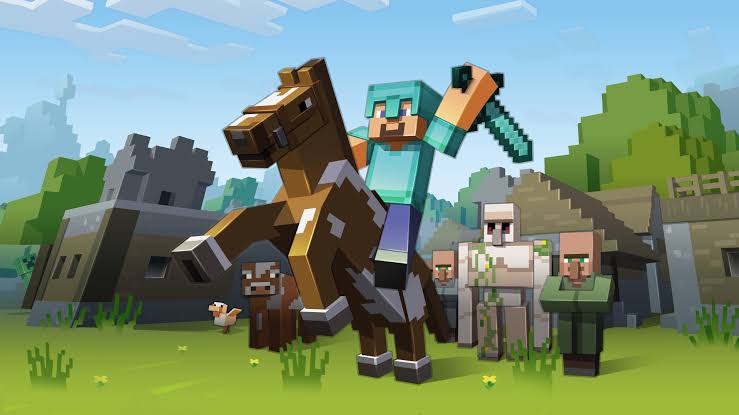
Most Minecraft survival worlds begin without a clear plan, as the sun sets and night approaches, players focus only on finding a safe place to survive, placing a bed, a few chests, furnaces, a crafting table, and maybe a small farm without considering whether the location deserves to become a permanent base, yet convenience quickly creates attachment because once resources begin to accumulate in one place, moving them elsewhere becomes increasingly inconvenient. A temporary shelter can quietly evolve into the center of an entire world, as one chest becomes many, farms expand, animals are kept nearby, and a mine entrance appears behind the house, until players realize they have invested enough time that relocating feels harder than continuing to improve a place they never intentionally chose. This pattern is extremely common in Minecraft, where players do not consciously decide to build a main base at a specific moment but simply stop leaving, even if the location is imperfect with awkward terrain, limited space, or inconvenient resources, because each upgrade makes it harder to admit that a better place might exist.
2. A Beautiful View Can Become Annoying When You Use It Every Day
Minecraft generates landscapes that immediately inspire building, from mountains and cliffs to lakes, forests, coastlines, and dramatic valleys, all of which can make a location appealing at first glance, yet beauty does not always equal practicality. Steep terrain can make expansion difficult when adding storage, farms, villager systems, or large builds, while dense forests create atmosphere but obstruct construction, and isolated islands look attractive but make resource gathering time-consuming. This does not mean players should always choose flat plains to optimize everything, since doing so can remove personality from the world, but instead the challenge lies in understanding the inconveniences of a beautiful location and deciding whether adapting to them is worthwhile. Experienced players often treat terrain as part of the design rather than an obstacle, turning cliffs into vertical builds, rivers into transportation routes, and uneven land into natural districts instead of forcing everything onto a flat surface.

3. Nearby Resources Matter Most Before Systems Reduce Distance
In the early game, base location has a major impact because basic resources still require direct travel, including wood, food, animals, caves, villages, and different biomes, all of which determine how much time players spend moving around. A base near multiple resources feels efficient immediately, as preparation becomes faster, food is easier to maintain, materials are easier to gather, and projects are less interrupted by long trips, but this advantage gradually changes as players progress, since farms make resources renewable, storage reduces repeated gathering, Nether travel shortens distances, and better equipment makes long journeys easier. As a result, the importance of location does not disappear but evolves, shifting from what is nearby in the early game to how well the base connects to distant areas later, which explains why a location that feels perfect early on can become inconvenient in the late game.
4. Storage Makes Moving Much Harder Than Building a New Base
Building a new house is rarely the reason players hesitate to relocate, since Minecraft allows almost anything to be rebuilt with enough resources, but the real challenge lies in everything inside. After many hours of gameplay, players accumulate large amounts of items, including building blocks, equipment, rare materials, and unused resources, and moving all of them becomes a project larger than constructing a new base itself. Storage systems therefore create attachment, as a chest room is not just organization but a collection of the world’s entire history, forcing players to choose between moving everything, which takes time and effort, or leaving some behind, which complicates resource management. Even with portable storage solutions, the problem is never fully solved once a world becomes large enough.

5. Building Too Close Together Can Make a Base Feel Finished Too Early
In the early stages, placing everything close together feels convenient, with houses, farms, storage, and animal areas all within reach, but as ambition grows, space quickly becomes limited. Farms need expansion, storage requires more rooms, new builds need space, and technical systems begin to appear, making the original compact area insufficient for further development, which is when players realize that empty space is also a valuable resource. Leaving gaps between early structures may seem wasteful at first, but over time it allows paths, landscaping, and new projects to connect naturally without constant demolition.
6. The Nether Can Turn a Remote Base Into the Center of the World
A location that feels inconvenient in the Overworld can become extremely useful once players utilize the Nether, since traveling between dimensions significantly reduces distance and allows efficient connections between distant areas. This changes how location is perceived, as a base no longer needs to be close to everything but instead needs strong connections, and a well-designed Nether portal network can integrate remote locations into a unified system. However, this also creates a new form of commitment, because once significant time is invested in building the network, relocating means redesigning the entire system.

7. In Multiplayer, Location Becomes a Social Decision
When playing with others, base location affects not only resources but also interaction, as building too close can cause conflicts over space and style, while building too far apart reduces player interaction. Successful multiplayer worlds often balance personal space with shared areas, allowing players to develop independently while still having reasons to meet, making location a matter of coordination rather than purely individual choice.
8. Sometimes the Best Upgrade Is Leaving Your Old Base
After a long time, an original base may become efficient but uninspiring, as everything is optimized and no new challenges remain, and building a new base can restore a sense of progression by forcing players to adapt to new terrain and experiment with different styles. This does not mean abandoning the old base, since Minecraft allows multiple bases to coexist and connect, turning relocation into expansion rather than replacement.

Conclusion
Minecraft offers near-total freedom in choosing where to live, yet that freedom makes the decision increasingly important over time, as a temporary shelter gradually becomes the center of the world through storage, farms, paths, and interconnected systems. There is no perfect location, only choices that match a player’s style and the challenges they are willing to handle over many hours, and although you can always leave, the hardest part is deciding when everything you have built is no longer a reason to stay.
Frequently Asked Questions
Is Minecraft still worth playing in 2026?
Yes, Minecraft remains highly enjoyable, especially for players who love survival, exploration, building, and creating personal goals.
What makes a good location for a Minecraft base?
A good location balances resources, space, expansion potential, and visual appeal.
Should beginners build near spawn?
Not necessarily, since exploring further can lead to better locations.
Is it worth moving an established Minecraft base?
It can be, especially if the current base no longer fits your needs or inspires you.
Why should players leave empty space around early builds?
To allow room for expansion and larger future projects.
How important is Nether access when choosing a base?
Very important in later stages, as it enables fast connections between distant areas.
Should storage be centralized in one place?
It is convenient but can make relocation more difficult.
Why do players become attached to old Minecraft bases?
Because they contain history, resources, and the entire progression of the player’s journey.